Future Culture

Futurist Writer Lei Kalina writes her tongue-in-cheek musings and ramblings on the growing worldwide phenomenon of the growth of the Future Culture in the 21st Century

Future Culture In The 21st Century

Future Culture In the 21st Century

Futures Studies, Foresight, or Futurology , according to Wikipedia, is the science, art and practice of postulating possible, probable, and preferable futures and the worldviews and myths that underlie them. Futures studies (colloquially called "Futures" by many of the field's practitioners) seeks to understand what is likely to continue, what is likely to change, and what is novel. Part of the discipline thus seeks a systematic and pattern-based understanding of past and present, and to determine the likelihood of future events and trends. Futures is an interdisciplinary field, studying yesterday's and today's changes, and aggregating and analyzing both lay and professional strategies, and opinions with respect to tomorrow.

Tuesday, October 28, 2008

The Mobile Dress: Fashion Gets Smart


FANCY YOURSELF in the middle of a crowded party, with each and every party animal you can think of present in attendance, all wired up with their techie gadgets galore. And then a phone rings, with everybody reaching out to their gadgets, but all you do is raise your hand to your lips to answer the call.

Watch how everyone’s jaws drop , all eyes glued on you and your , ehem, M-Dress, a.k.a. The Mobile Dress, working with a standard SIM card, using soft circuitry and gesture-recognition software, and functioning like a mobile phone.

Thanks to UK firm Cute Circuit , an interactive design consultancy and research lab founded by Francesca Rosella and Ryan Genz specializing in wearable computing, art installation and education, the group which invented the M-Dress , and currently earning raves.


University of Wales Smart Clothes and Wearable Technology Director Jane McCann told CNN the clothing and electronics industries are collaborating in an unprecedented way -- describing this interesting fusion of futuristic fashion and technology, wherein electronics are embedded in clothing fabrics as "a new industrial revolution."

McCann's prediction for the next-decade futuristic fashion: clothes will have all kinds of
built-in functionality, as designers dabble with blue tooth technology, sensors, and electronic gadgets incorporated in garments.


"A garment might have devices on it to help you find your way somewhere, or to tell you how fit you are. It could tell you where someone is to help you meet them, or tell you what's on at a museum or club," she told CNN.


Still, analysts observe that the fashion industry is , yes, still “lagging behind” as far as wearable technology is concerned, as compared to sports and fitness industries leading in its tech innovations via its built-in pedometers and active wear with integral iPod controls.


McCann agrees: "Wearable technology is coming through into useful everyday clothing more than it is on the catwalk. The catwalk still treats wearable tech as flashing earrings or sensational things.”


Meantime, seems like there's no stopping the ingenuity and creative juices of maverick fashion designers, getting bolder and more daring in their fashion innovations. Chinese designer Vega Zaishi Wang used electroluminescent lamps to light up her creations at Central St. Martin's graduate show earlier this year,


Hussein Chalayan's "Readings" fashion collection made use of moving lasers to emit bright red beams, plus Swarovski crystals on the dresses "to deflect and absorb the beams", while his other innovations include putting mini-LEDs --- thousands of them --- in stunning dresses which show moving video images, blurred by the garments' fabrics.


Another Chinese designer , Angel Chang , collaborated with German artist Johannes Wohnseifer to create a range incorporating a world time zone map made with heat-sensitive ink; and if you touch New York on the map, it turns yellow . She further worked with Noble Biomaterials to create the "self-heating vest" : a conducting silver fabric transmitting heat to keep the wearer warm, and without any wires, to boot.


http://www.telegraph.co.uk/fashion/graphics/2007/06/03/tsang400.jpg


And there's more: Joanna Berzowska and Di Mainstone's Luttergil Dress, with seams slowly opening and peeling, with its movements regulated by filaments of shape-memory alloy and controlled by an electronics board ; Alphamicron is working on the so-called liquid crystal technology to create color-changing clothing ( such as sequins getting darker when exposed to sunlight) ; Amanda Parkes makes use of piezoelectric materials which generate power from the wearer's movements , with energy stored in a small battery and later discharged into a minuscule device ; Fabrican, a spray-on fabric device used to personalize existing fabrics, or sprayed on directly to the skin to "make fabric" .


Even moving flowers on the clothes? Yep: Kukka flowers by Berzowska, Marcello Coelho and Hanna Soder, which close and open , using a shape-memory alloy called Nitinol to make the flowers slowly change shapes .


And what about the "environmentalist skirt" ? Stephanie Sandstrom's EPA dress , fitted with sensors which measure air quality , simply crumples and "cringes" --- in response to "bad air" .


Kerri Wallace's Motion Response Sportswear uses thermochromic ink to change color with body temperature ; while Yun Ding's Aqua Chameleon Swimsuit used photochromic ink, thermochromic ink , and UV thread which changes color when exposed to sun, water and varying temperature. Philips' Lumalive Textiles , meantime, is a light-emitting fabric containing LEDs which display text or moving images.


As far as futuristic fashion technology is concerned, well, the future looks bright, indeed.


http://www.style.com/slideshows/standalone/trends/features/year2006/18m.jpg

McCann's predictions:
mass customization will emerge as a major trend in clothing technology, when people go into sizing booths to get measurements of their sizes and shapes, or perhaps a microchip used to customize clothing . "In theory, if you've got technology that's cutting out garments one at a time it could produce clothes informed by our own size requirements."


http://www.style.com/slideshows/fashionshows/F2008RTW/CHERRERA/RUNWAY/00100f.jpg

"And you might want built-in controls for an MP3 player but I might like heart-beat monitoring. I'd like mine to have a digital print of the sleeve but my friend wants a picture of her boyfriend on the back. Some of that could happen in the 10 years," McCann adds.


Futuristic Fashion


MODERN TECHNOLOGY combined with the knock-‘em-dead creative geniuses in the fashion world --- perfect combination to send the cynics and skeptics’ heads a-whirlin’ and a-twirlin’ .


Now , this is great stuff to talk about in the 21st century!


First, there’s the so-called space couture design which is making head-turning, eyebrow-raising, and even hair-raising inventions, via the “zero gravity wedding dress” . Japan's Aerospace Exploration Agency recently held its “starry eyed fashion competition” Space Couture Design, and to launch it, chairperson Eri Matsui, has designed the wedding dress which transforms when on zero gravity area.


Space couture design

Zerogravity


( www.shinyshiny.tv reports: on the left of the photo is the "zero gravity wedding dress",as it would look on Earth, and the right version shows how the dress would appear in zero gravity )


Cute Circuit, an interaction design consultancy and research lab founded by Francesca Rosella and Ryan Genz specializing in wearable computing, art installation and education, has more up its sleeve.


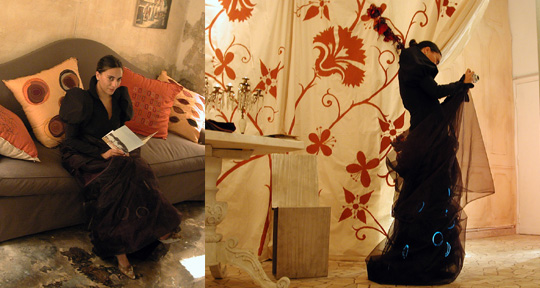
There's the Kinetic Dress, changing patterns when the wearer interacts with others or walks. If the wearer stands still or sits alone, the dress is just black, when she moves and interact with others the garment slowly lights up with a blue-circles pattern that creates a magic halo .


KineticDress.jpg


The Skirteleon, meantime , is a skirt chameleon based on a laminated fabric that changes color "on-demand": blue in the morning when the wearer is working, then shows a pattern with animal characters when the wearer is with friends for an drink, and in the evening it displays a japanese pattern. Unbelievable .


And then there's Mystique, also much like a dress chameleon which changes its shape and length : while the night is young, the knee-length dress is in pale gray color with a soft padded surface. But as the night deepens, just like a lady trying to curl up with the nighttime chills, the dress gets longer, and even changes colors! Wow!


Techiediva.com reports Cute Circuit's invention of the "world's first interactive wedding dress" called the "Kiss Me" gown and suit made of pure Indian Silk for a lucky couple in Sweden who tied the knot in a very original way.

And at the dramatic conclusion of the ceremony, when the happy couple kissed, two messages containing before unspoken love words were passed from one to the other (one from him to her, and one from her to him). The messages are shown only to the couple through a miniscule display integrated inside the trim of the clothes for absolute romantic-secrecy... The wired garments transform into regular outfits that could be worn many times after the honeymoon is over. The wedding gown’s train is removable so the skirt could be turned inside out for a change of color."


http://shinymedia.headshift.com/images/images/cute_circuit_interactive.jpg


Cute Circuit proponents explain their "wearable technology" :

"At CuteCircuit we are working on making technology that is more usable, emotionally fulfilling, and fun! We think that wearables will be the future tool for personal communication. Like a dynamic surface around our bodies able to connect us to people and places. The most used communication tool today is the mobile phone, we believe that the wearable technology and the telecommunication market will merge in a not very distant future. Many of our wearables are compatible via Bluetooth with mobile phones, this allows for a faster deployment and adoption of this technology."

"CuteCircuit wearables are beautiful and pleasant to wear: no loose wires, no hard shells, and no backpacks full of batteries or visible technology (unless for decoration). We pay great attention to details and technological solutions in a sartorial view of technology."

"The wearable technologies that we develop are RoHS compliant, it means that no lead or mercury are present in the garments. We design technology that is safe for both the wearer and the environment."


www.Cutecircuit.com


Featured Projects

PLEAT

hand-made heat-formed textile

PLEAT is a collection of garments featuring hand-made heat-formed textiles. The collection features a waterproof jacket, with a layer of pleated organza covering a sleeve and part of the front, a pleated dress where the pleats can be reversed to make the dress more or less tight on the body, and a skirt, embroidered with heat-formed pockets. The heat-formed textiles reatain their shape even when they are stressed by daily use of the garments or after washing.

Hug Shirt

Hug Shirt Profile


The Hug Shirt is a wearable Bluetooth accessory for your mobile phone. The Hug Shirt allows to exchange the physical sensation of being hugged over distance through telecommunication networks.

KineticDress

Kinetic Dress Pattern


The KineticDress is part of the Transfor-Me collection developed for the NEMO Science museum in Amsterdam. The KineticDress changes color and pattern depending on the activity of the wearer.

Skirteleon

Skirteleon Pattern


The Skirteleon is part of the Transfor-Me collection developed for the NEMO Science museum in Amsterdam. The Skirteleon changes color and pattern “on-demand” depending on the activities and mood of the wearer during the course of the day.

Mystique

Mystique Dress

The Mystique Dress is part of the Transfor-Me collection developed for the NEMO Science museum in Amsterdam. The Mystique Dress changes shape and color depending on the time of the day increasing in length from morning to night.

A-Nerve

Accessory Nerve

The Accessory Nerve is a Bluetooth wearable accessory for mobile phones. When the Accessory Nerve receives an incoming call the fabric pleats on the sleeve change pattern.

Embedded Theater

Child wearing ET headset

Embedded Theater is a wearable augmented-reality device. The Embedded Theater analyzes the user location and direction of sight and the system delivers audio narrative and navigational information.


Sunday, October 12, 2008

Humanitarian Tech In Action

Either I was about to guffaw uncontrollably, or widen my eyes in shocked amazement at what I heard . We were at Mapua Institute of Technology Manila where I hosted the thirteenth leg of our Manila Futurists Society seminar-event campus tour last September , and I was chatting with a communications professor when, I heard him say with utmost conviction that technology is "immoral". Duh.

Of course I thought I heard wrongly... but yes, he really meant it. Cannot believe my ears, really.

How can this happen in this day and age? I asked myself.

Just when scientific advancements and technological breakthroughs have been making milestones year after year
--- whether it be in the field of health and medicine , cyberculture and information technology, business and society --- some "unenlightened " souls are still suffering from "future shock" , scared of technology, fearful and intimidated by scientific breakthroughs and technological achievements.

And today, I stumble upon PopSci.com's feature on "Humanitarian Tech In Action" --- samplings of how technology helps humanity in the Third World for year 2008, a ready helping hand for rural India, tsunami-ravaged Indonesia, and far-flung areas of Sierra Leone .


Check it out: http://www.popsci.com/scitech/gallery/2008-09/humanitarian-tech-action


Digital StudyHall
Build Change


Arcadia Biosciences, Inc.

Sunday, October 5, 2008

"I'll Be With You In ... 'Robotic Spirit' "

Whew . Don't you just wince and roll your eyes everytime you hear somebody saying that they can't make it to your party, or to your meeting... but will be with you "in spirit " ??

Har, har, har.

Some kind of a hair-raising "out-of-body experience" , or simply a polite excuse , a courteous exit.


But for RoboDynamics Corporation, they're introducing the TILR ( Tele-presence Internet-connected Low cost Robot ) Robotic Telepresence comprised of three distinct components, which include a robot (TiLR), a PC application (TCC), and a Robot Server (RS) .

Check this out.


TiLR - a mobile robot platform almost four feet tall that features a video camera and display. TiLR connects to your organization's wireless network via a standard WiFi connection and can be controlled remotely via TCC.

TiLR Command Center (TCC) - is a software component that installs on almost any PC - and is used in conjunction with a webcam and broadband connection to commandeer TiLR remotely.

Robot Server - is a thin server that maintains the status and locations of robots in your organization and allows user to easily find and connect to robots within your organization.

Robotic Telepresence System

RoboDynamics' report :


TiLR - World's first commercially available Robotic Telepresence Platform

What is Robotic Telepresence?

Robotic Telepresence is the ability to transport yourself to a remote location without going there.

It is similar to video conferencing but whereas video conferencing gives you only a small window into the remote world, Robotic Telepresence gives you a presence, instantly transporting you there and enabling you to move around, look about, and interact with people, objects, and the environment as if you are actually there.

TiLR - Robotic Telepresence vs. Video Conferencing

Our robot, named TiLR (pronounced Tie Ler) has an 8" LCD screen and a powerful Canon camera - providing you with live bi-directional video and audio. As such it brings you face to face with people and objects - and gives you the freedom to move about the remote world from the convenience of your PC - wherever in the world you may be.


TiLR - Robotic Telepresence vs. Video Conferencing

Robotic Telepresence versus Video Conferencing


Video Conferencing Robotic Telepresence
Presence


Your sense of presence is limited to the narrow view that a camera provides - often times just a face.


Your ability to move freely about the remote space has the profound psychological effects. Both you and people on the remote end treat you as if you're actually there in person.

Synchronicity

Synchronous:
all video calls must be scheduled in advance - which is often burdensome, difficult to manage, and essentially downtime.

Asynchronous:
telepresence sessions happen whenever you want them to happen. No need to waist time scheduling and no need to be tied down to a specific time.


Space

Video conferencing affixes you the specific location where the VC equipment is located - and you can't deviate from that location.

Robotic Telepresence provides the ultimate freedom of mobility, enabling you to move about the entire traversable space of the remote location.


Interactions


Formal
: video conferencing sessions tend to be formal with rigid, prearranged agendas.


Formal and Informal
: with Robotic Telepresence you can have formal interactions as well as informal ones. You can spend the day with your colleagues - be at the water cooler - and work seamlessly with your team even though you're away from the office.


Inter-operability

Difficult
: Video conferencing equipment vary from location to location - even inside an organization. Sessions with outside organizations are even more difficult, as significant upfront work is required to ensure inter-operability of varying systems.


Easy
: Connecting to a Telepresence Robot is a matter of installing a software. By nature, anyone can connect to a TiLR with a PC, Webcam, and Broadband connection. No specialized equipment or expertise is necessary.
Empowerment


The rigid nature of video conferencing divides the power of the meeting between participants on both sides. Each side is at the mercy of the other to answer, maintain, and terminate the session.


With Robotic Telepresence the user is empowered to visit and maintain the session at will. It is analogous to you walking down the hall to your colleague's office.


For Crunchgear.com's Devin Coldewey, teleconferencing can be " an impersonal affair — all your subordinates just staring at a laptop screen, and on the screen is a window, and in the window is a smaller screen, and in that smaller screen is your face. So lifelike! You could also do the evil overlord thing where you’re projected all big on the wall (asking for one million dollars). "

"But the approach RoboDynamics wants to popularize is what they call “telepresence,” and it necessitates inhabiting a robotic body in the room. Now, let’s be honest: the notion is a little more grand than the execution. TiLR looks like a riveter robot with a screen for a head, but the idea is sound; you can scoot around, tilt and pan its camera, and talk face to face with people in the remote environment."

Are we looking at some future office scenario, when this robotic telepresence is the virtual alter-ego of the CEO, doing his routinary peep-ins in office cubicles to say hello and see if everybody's buckling down to their jobs? Should this be the stuff of our corporate future : adding to spy cameras at every office nook and corner , breathing down your necks to see if you finally got your spreadsheets right? Hmmmm.....


CIMG1208

Just recently , TiLR was given an opportunity to "work" at the X Prize Foundation for the Google Lunar X Prize liaison office. In this capacity TiLR will enable remote workers to participate at staff meeting by using TiLR as their office avatar.


Thursday, September 18, 2008

You Humanoid , Android You !

Er, don't look at me: I'm not your average Stars Wars fan, and that Keanu Reeves series of The Matrix almost made me puke in boredom and disgust. Sounds like an anti-futurist to you?

Well, it seems that the 21st century --- yes, still at its infancy stage --- is heading for a good future of androids' and humanoids' population. Surely you've heard of Baby Bots, and nurse robots... and that female robot , looking much like a Japanese with chinky eyes ( yep, made in Japan) which would pull its face askew as soon as it hears the words "George Bush."

When Lee Majors started the thought of half-man half-machine with "The Six Million Dollar Man" series , there's no looking back. C3PO and R2D2, that robotic duo who bungled things up in outer space during their "Star Wars" popularity, Arnold Schwarzenegger's "The Terminator", all made their steely presence felt that artificial intelligence and robotics would soon come up with a robotic population that would be making our digital lifestyles easier , more fun , and convenient for all.


by Clockwise from top right: Courtesy USC/CLMCâ€Lab; Courtesy Center for Intelligent Systems; Courtesy Sony; Billy Yip, Man Piu: Photo by Clockwise from top right: Courtesy USC/CLMC–Lab; Courtesy Center for Intelligent Systems; Courtesy Sony; Billy Yip, Man Piu; Courtesy Air Intelligent Robotics and Communications Laboratories

Movie humanoids, from C3PO to the Terminator, have long been able to see, hear, think, and socialize. Today's real-life humanoids–robots with the mechanical equivalents of eyes, head, arms and hands–are finally beginning to catch up. The five bots here are the standard-bearers.


(Clockwise from top right)


Robovie
Robovie was designed as a personal companion by Hiroshi Ishiguro's team at the Advanced Telecommunications Research Institute International in Kyoto, Japan. It turns to face a person who's talking to it, maintains appropriate social space during a conversation, points to objects with its finger, and bends down to play with children.


DB
Perhaps the most agile humanoid, the life-size DB, designed by Sarcos Research Corporation, can balance a pole on its palm, juggle, and perform an Okinawan folk dance. It does some serious science too: Stefan Schaal's team at the University of Southern California uses it to test theories of motor control-how the brain plans and generates movement.


ISAC
It resembles an animated junk heap, but ISAC makes up in creativity what it lacks in looks. Designed by Alan Peters and colleagues at Vanderbilt University, ISAC can express simple emotions and has both short- and long-term memory. Soon, it may even "dream," shuffling its neural connections just as we do when we're sleeping, which could help it devise
creative solutions to thorny problems.


Sony's Dream Robot
It's only two feet tall, but Sony's Dream Robot can wake you up in the morning, tape a television show for you, and ask how your day was. SDR-4X, the latest version, sings, dances, and recognizes voices and faces. It's due out in the U.S. within the next two years-at a cost rivaling that of a luxury car.


RoboSapien
RoboSapien's novel engineering allows it to do kung fu moves, pick things off the ground in less than a second, and run "so fast it scares cats," says de-signer Mark Tilden, a robot physicist at Wow Wee Toys, a division of Hasbro. Instead of using computers to calculate how to move, the 14-inch-tall RoboSapien, which will retail for about $80 when it hits stores later this year, uses analog transistors to react to signals from the world around it.

( courtesy of Popsi.com)

Big Wheel , Keep On Turning


"Big wheel , keep on turning... Proud Mary, keep on burnin'..."

Sure, I remember that 70's Tina Turner ditty, watching those re-run classics and having Tina's or (Anna Mae Bullock's ) rhythm and blues ringing in my ears.

Fast forward to the 21st century:
It's called the Monovelo : the first available human-powered monowheel, making its grand entrance during its exhibition stunts at the recently-concluded
2008 Beijing Olympics. With its maximum speed of 20 kilometers per hour --- so that's some 12.5 miles per hour , you're up from some cool-and-suave cruise... if you're trying to save on gas , if you don't mind getting a suntan as you pedal your way to work, and if it makes you happy and ecstatic sniffing all the smog of the metropolis and having it land on your face as your improvised face powder.

With a net weight of 38 kilograms and a gross weight of 52 kilograms , made of ABS plastic wheel, rubber tires and steel frame, some cynics are doing the smirking bit that it's not gonna work, and would be gone in no time.


Check out www.popsi.com's report:

Can't let go of the Olympics? While it's unlikely you'll be able to purchase 2008 Chinese drummers to play at your next barbecue, apparently the big human-powered wheel from the closing ceremonies can be yours for the bargain price of $1690.

The Monovelo claims to be the first commercially available human-powered monowheel. Built from ASB plastic combined with a steel frame and a rubber tire, the contraption measures just under seven feet in diameter and weighs in at 84 pounds. The device claims a maximum payload of 220 pounds, so lay off the burgers.

Monovelo claims it could be a great advertising tool and is even street legal in most countries. With a top speed of 12.5 miles per hour, that's a lot of good exposure time.


Yep, good point: it could be perfect for advertising strategies ... Coca-cola and Pepsi can attract attention with these eye-catching thingies in big concert events, campus productions, and even political rallies (!) Sure, for cryin' out loud. 2010 is just around the corner, and Philippine political circus would be more colorful with this Monovelo bonanza troopers pedalling away for some eye-popping scenarios.


Just imagine the 2010 presidentiables --- Manny Villar, Mar Roxas, and Ping Lacson biking away in these circus-y, flambouyant unicycles as they parade for their bid for the Presidency.


However, don't get caught with these along the skyways and metro routes in the Philippines: lest you want the thrill of getting it smashed to pieces, with your own limbs.


Eeeeeeoooow!

The Future of Mobile Computing

Check out PopSci.com's report :


Future Phone: With Android, Google is betting that the future of computing will be handheld.

When MIT professor Hal Abelson heard that Google was about to release the software-development kit for its free, open-source Android mobile-phone operating system, he immediately decided to teach a class that would design programs for it. “Android is about to change people’s experience of what they can do with computers,” he says, because the computers in our cellphones will soon be the ones we use the most. These seven applications, developed by students in Abelson’s class, show what Android-equipped phones will be able to do.

Loco
Loco will track your friends on a map by picking up GPS signals from other Android phones, so you can search for nearby parties.

Locale
Set your phone to change settings based on your location. You can make your ringer automatically switch to “vibrate” when you’re at work and then back to “normal” when you’re at home. Google has singled out this application for funding.

Geolife
This app will send you reminders based on location instead of time. For example, as you approach a grocery store, it will remind you to pick up milk.

Snap
Like a location-based, community-oriented Digg, Snap will show you the most popular locations (museums, stores and so on) near you, based on user submissions and feedback.

Re:Public
Re:Public will let you browse profiles of other users in the neighborhood, see what events they’re attending, and track their their location in real time.

Kei
By communicating with Bluetooth-enabled hardware in your car, Kei will unlock your car door and start the vehicle without a key.

Flare
Flare allows you to track mobile employees, such as food deliverers, in real time through their Android phones.

Wednesday, August 20, 2008

Kindle Me Softly

kindlee


Wow, wait till I get my hands on these beauties ... If you're some techie geeky bookworm who's willing to break the piggy bank and splurge on these drool-worthy dreams, check out the Kindle.


Amazon's Kindle entered the tech scene last November 2007 , pitched by Amazon.com as an "e-reader allowing easy access to a vast library of electronic books to be downloaded and read on the device... with over 90,000 books available for download..."


"Books are loaded onto the device wirelessly via Amazon’s free EVDO network (called WhisperNet) and are published in a proprietary format for the Kindle. In addition to books, Kindle owners can also send files to Amazon to be converted and published onto the Kindle, and access blogs and newspapers through the Kindle’s browser. Kindle displays its contents via electronic-paper display, a new technology that creates a paper-like display for electronic text that is also used in Sony’s Reader product."

Amazon Kindle screenshot

Amazon Kindle screenshot


Gone are the days when you have your arms outstretched --- wary of your stranger-seatmates in the bus or subway train --- as you read your newspaper. With Amazon's Kindle , all you need is one hand and read away --- thousands and thousands of pages ---- read-till-you-drop.

And the e-book , initially in its boring beige / dirty white color, is soon to evolve this coming October with fuschia neon pinks and other shocking colors --- further to attract not just the business / enterpreneur market , but even the upper class teenyboppers and school-strutting graders .


CrunchGear reports:

"Consider the financial impact when the college market is more fully explored. Students are used to paying outrageous prices for textbooks. Even though the excuse “it’s the high cost of paper” wears thin rather quickly, students will always need texts. I’m sure future generations will hear “it’s the high cost of production” as the excuse for overpriced e-texts, but the fact remains students and texts go hand in hand. Just the simple luxury of not lugging around a heavy library should spark the market."


"The surge in e-readership may outpace expectations. While analysts agree that sales will grow, estimates vary wildly. Ultimately, with a solid base of almost a quarter million Kindles sold already, it might be time for a second look. Especially if we’ll be seeing a new Kindle soon."


After almost a year in the market ,
reliable sources say: 240,000 units have been sold, with $6,000,000 in revenue for every $25 worth of reading material purchased. The e-readers alone, sold between $360 and $400, have generated somewhere between $86 million and $96 million, and as more and more Kindles are sold, more and more reading materials go along with the shipped units.


Geez, it's so unfair, man. Analysts watch in envy: "It seems Amazon has tapped into a real and viable business."


Under wraps and about to be unveiled this October 2008: the new Kindle models, yep, just in time for the holiday crunch. Will the younger set love it ---- pink and pastel colors, looking like a sleek-svelte-and sexy Ipod mini? You betcha.


Business is doing good, and the Wall Street analysts are turning green with envy. " And if a new Kindle comes out targeted at the textbook/school market, sales could ramp up higher."


The original Kindle, which launched last November, has been widely regarded as a success, though Amazon has curiously refused to release any numbers related to its sales figures. In May, Citigroup Analyst Mark Mahaney estimated that Amazon may sell $750 Million in Kindles by 2010. The same report also guessed that Amazon has only sold between 10,000 and 30,000 Kindles to date, suggesting that it may display the same exponential growth seen by the iPod during its climb from 129,000 units sold in its first quarter to worldwide dominance, with over 100 million sold.


"Scott Devitt, an analyst at Stifel, Nicolaus & Co., predicts that Amazon is on track to sell 500,000 to 750,000 more Kindles over the next four quarters (including this one). He estimates that Kindle owners will buy an additional $120 to $150 worth of books and other content for each device, bringing the total revenues over that time period to somewhere between $225 million and $355 million. Based on that, he values the Kindle as a $1 billion business for Amazon."


"Back in May, Citi analyst Mark Mahaney was estimating that total sales of Kindle’s this year would only reach 189,000. That number may have already been surpassed (depending on how many of the 240,000 units Amazon sold before January). His estimate called for 467,000 units to be shipped next year, and 2.2 million in 2010, resulting in total revenues going from $60 million in 2008 to $741 million in 2010. It might be time for him to revise those numbers upward."


Geez. All you'll want for Christmas is, well, go tell your Santa Claus : )


Virtual Hugs, Hug Shirts, and Heart-Monitoring Clothing

CrunchGear reports:


"We get the weirdest crap in our tips inbox, most of it unpublishable (unless your filter allows through things like “Hard HORSUE sexx tranny”, as ours does). But then there’s things like this Hug Shirt. It connects to your mobile phone via Bluetooth. It has sensors as well as actuators. You have your Hug Shirt, your partner has their Hug Shirt. You hug yourself, and the sensors take the data from your hug and send it to your partner’s phone, where a Java application causes the actuators in their shirt to “hug” them."

"It’s more of a fax-a-hug, but whatever. Do we need this technology? I’d rather have a cure for any one of Hilton’s maladies. And I do mean those ones."


Hahahha... I'd say... Why not??? Sometimes, you and your better half would run out of great ideas on showing how much you care --- and those SMS, MMS, and mushy emails are squeezing your creative juices to the fullest. And with available technology to the tune of "fax-a-hug" , "virtual embraces" and electronically sent kisses ( it's called YM as in Yahoo! Messenger , folks) , why won't it be a welcome idea?


But with your Hug Shirt, make sure that nobody is watching you when you go through the motions of ooohh--and---aaaahh love Stylistics --- or risk having people create ideas that you're going loony :) Meantime , both you and your partner should be wearing the Hug Shirt at the same time --- for your "faxed hugs" to be felt.


But there's more from these mod fashion scenarios.


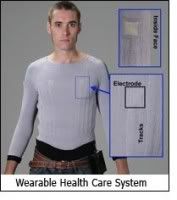
Adidas just came up with a hip shirt which --- while making you look cool as ever --- will also "cool down" your stress and woes about your heart rate . The sports fashion apparel company has tied up with Polar to produce a new line of clothing called Project Fusion , with double whammy functions of monitoring your ECG stats and heart rate , as well as making you look, uh . cool.


CrunchGear says:

"The system has sensors built throughout the shirt to check your heart rate and the shoes to keep tabs on how far and fast you’re moving. After your workout, just upload all the info to your PC via Bluetooth and see how you did, and how long it took you to recover. The sensors are supposed to be soft, as not to be uncomfortable and the transmitter that collects all the data is firmly planted in the front of the shirt, so it’s easy to recognize and use."


For a whopping US$680 price, it certainly doesn't come cheap: but the pricey stuff would go a long way in saving lives --- especially those with heart ailments. One thing though: one quick look and it shows that it would look kinda funny if you have "love handles" on your sides, and extra fat and bulges everywhere --- it only comes in a one-size-fits-all fashion.


Before you get the courage to wear it ( like me) ... better do a lot of huffing and puffing in the gym to carve your body into some strut-your-stuff figure. But then, you'll need it all the more while you're exercising. So there's the rub.


Snooze Email: Hit Me Later


Now, this is a beauty.

Sometimes you just feel like you’re swamped by too much emails --- everything urgent, everybody trying to get your attention , and the spam button , for crying out loud , isn’t any help either.

Sure, you can call me one of those inbox clean freaks --- classifying each email ( I get tons of emails in a daily grind) and carefully tucked in separate folders, whether it be my longtime Sylvia’s forwarded messages, or my college friend’s forwarded email blast jokes, or Friendster’s horrifying load of email notifications ( finally turned it off, whew!) , until I sweep the inbox clean and spic-and-span neat. Then came a loadful again after a few hours . And my come-from-behind remorse. Now why did I subscribe to this $&*# mailing list ???

To the rescue , ta-dahh! Here comes HitMeLater .

Tech Crunch reports:

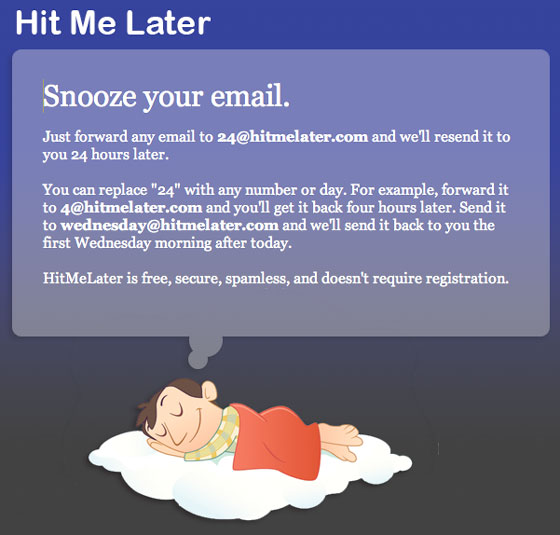
“HitMeLater is simple. Forward any email to 24@hitmelater. com and it will send it back to you 24 hours later, putting it on the top of your inbox pile. You can change the number of hours to anything you like, up to 1,000 hours ahead (3@hitmelater. com sends it back three hours later). Alternatively, put in a day (Wednesday@hitmelat er sends it back the next Wednesday).”

“If you send it something it doesn’t understand, HitMeLater sends back a polite email message saying “We’re not sure what you want.”

“If you’re like me you rely on flags to remember which emails to go back to, but they often get buried and are left unattended. From now on I’ll forward stuff I need to deal with but not immediately to Sunday@hitmelater.com, my slowest email day.”

While some are already grouching and snarling this early ( “Why should I use such a service when I can always use my desktop for some ‘Remind Me Later’ tasks?” ) , I guess it could be something like a virtual online assistant --- nudging you about that all-too-important task or event but can wait for another 24 hours or more --- because you’re currently drowning with too much ASAP work . Whew!

Philip Kaplan’s cool new service may not be that hot for some , this HitMeLater. thing has some valley wags and techie geeks raising their eyebrows in cynical fashion. But the guy is something else :

“Philip oversees AdBrite’s product management and innovation. Prior to founding AdBrite, Philip founded several businesses including PK Interactive, a software company that developed Web-based applications for Fortune 500 clients including Toyota and Mead Paper. Philip’s personal sites have earned accolades including Yahoo and Rolling Stone’s Site-of-the-Year, and #6 in TIME Magazine’s “Best of 2000.” Philip is a regular public speaker and is the bestselling author of F’d Companies (Simon & Schuster). He is on the board of the School of Information Studies at Syracuse University.” (Source: AdBrite)

Oh well. If you have some comments … hit me with it later . : )

Wednesday, August 6, 2008

The Next Ten Years of Web Future

Curious about the next ten years of cyberculture? Check out what the experts say:


The Future of the Web

We asked technology innovators, luminaries, and users what the Web might be in five to ten years.

By Kristina Grifantini
http://www.technolo gyreview. com/read_ article.aspx? id=20943&ch=specialsections&sc=futurebiz&pg=1


Sir Tim Berners-Lee
Director of the World Wide Web Consortium and inventor of the Web; Cambridge, MA


"I would like to see the Internet reach people in rural areas and help alleviate poverty. I would like to see more people reaching the Web from devices big and small, fixed and mobile. I look forward to more voice technology-- in hands-busy scenarios such as driving, and also to increase accessibility (e.g., for people with low vision).


The long tail of video on the Web is creating a new market of direct access to independent films and also has the potential to help with literacy issues. I hope for the proliferation of Linked Open Data: the Semantic Web 'done right.' I hope that governments will open their data stores to all citizens. A mashup sphere will feast on a wealth of Semantic Web data and herald the next wave of progress and creativity on the Web."


Vint Cerf
Vice president and chief Internet evangelist at Google and co-designer of the TCP/IP protocols and the architecture of the Internet; McLean, VA


"There will be higher-speed Internet access by fiber and wireless media. Seventy percent of all mobiles will be Internet enabled in 10 years or less. Gigabit speeds in wired and wireless modes will be more widely available. Many more appliances (home, work, car, on your person) will be online.


IPTV will offer radical new consumer-controlled advertising opportunities. IPv6 will be the dominant mode of access and use of the Internet. Multi­touch and voiced interfaces will be very common. Devices will discover each other when they are local and interact in a P2P fashion."


Richard Stallman
Main developer of the GNU/Linux system and founder of the Free Software Movement; Cambridge, MA


"No one can see the future, because it depends on you. But I see a danger in the Web today: doing your computing on servers running software you can't change or study, and entrusting your data to U.S. companies required to give it to Big Brother without even a search warrant. Don't risk this practice!"


Bjarne Stroustrup
Professor at Texas A&M University and designer of the C++ programming language; College Station, TX


"The total end of privacy. Governments, politicians, criminals, and friends will trawl through years of accumulated data (ours and what others collected) with unbelievably sophisticated tools. Obscurity and time passed will no longer be covers."


Mena Trott
President and cofounder of Six Apart; San Francisco


"With the popularity of blogging and online video and photo sharing, we already know that people want to publish significant portions of their lives online. In 10 years, I can easily see someone putting 75 percent of their day online. But it won't all be public. The ­majority will be for that person's eyes only; it will be more a record for that individual."


Leah Culver
Cofounder of Pownce; San Francisco

"Open standards will always be the future of the Web. Developers should be able to rely on their programs' running well on multiple platforms. Simple and open API standards such as Microformats, ­OpenSocial, OAuth, and OEmbed will help developers build the next generation of Web applications that we love."


Jonathan Zittrain
Professor of law and cofounder of the Berkman Center for Internet and Society at Harvard Law School and author of The Future of the Internet--and How to Stop It; Cambridge, MA


"The future of the Web may be its past: an abandonment of open standards and services (like the collective hallucination that is our distributed e-mail system) and a return to the gated communities that offered consistency and security--and also lock-in. To avoid this future, application developers must pressure the makers of cool new platforms like Facebook and Google Apps (or the iPhone, for that matter) to abandon their ability to kill any apps at any time for any reason."


Marc Benioff
Founder and CEO of Salesforce.com; San Francisco


"The future of the Web will all be about developer empowerment. We have seen the Web disrupt and dis­intermediate content and commerce, and now software development is next. Companies such as Salesforce.com, Google, and Amazon are making it possible to create and run powerful business applications in the cloud, and that will change the economics of the software industry forever."


James Pearce
Vice president of technology at ­dotMobi; Dublin, Ireland

"The mobile Web. In 10 years' time we will look back at those quaint few years when our online experiences required us to sit at a lonely keyboard and screen. You don't have to sit by a hi-fi to listen to music in the 21st century. Why should you have to sit at a PC to use the Web?"


Mohit Hira
Director at ­Indiatimes.com; Gurgaon, India


"Web 2.0 and social networking are the latest fads in India, like the rest of the world. But here there is also a quiet--almost underground- -movement to incubate new ideas specifically relevant to the Indian user's needs. From languages to mobile applications, we will see adaptations of existing sites and platforms that will appeal to Indian youth. Cricket, movies, and music are likely to be the three cornerstones on which most of the Web will evolve."


Erik Hersman
Cofounder of Usha­hidi and author of the blog Whiteafrican. com; Orlando, FL, and Nairobi, Kenya

"The future of the Web in Africa is the mobile phone. SMS and voice will be used to augment existing social networks, empower trade, and increase information sharing. While there will be continued development in the traditional Web space as data networks become more robust, the true explosion will only come on a ubiquitous and affordable device."


Mohamed Nanabhay
Head of new media at Al Jazeera; Doha, Qatar


"In the Middle East, the Web has allowed a wider spectrum of voices to be heard in a region where the media has traditionally been tightly controlled by governments. I expect this characteristic of the Web--its ability to amplify the voices of those who could not be heard--to become more significant, and the Web's impact upon society to grow, as Internet and mobile penetration increase and the online ad market matures.


There will be an explosion of ­activity on the Web over the next decade, driven by the region's youth boom."


Jonathan Abrams
Founder of Socializr and Friendster; San Francisco, CA


"In five to ten years, we will all have chips in our brains. When you look at someone's face on the street, your Google Brain software will automatically call up every embarrassing photo of them from ancient websites such as Flickr, Facebook, and MySpace; list all mutual friends; and remind you of the person's annotated bio.


As a response to the perceived slowness and verbosity of antiquated services like Twitter, people will send everyone they know nanobursts of information about anything they might do or think before they actually do or think it. Every website, blog, and social-networking profile will include an aggregated feed from every other website, blog, and social-networking service, resulting in an exponential and infinite length of repeated content on every possible site, overloading our brain chips and causing frequent nosebleeds and occasional cerebral hemorrhage."


More of readers' comments / replies:

http://www.technolo gyreview. com/read_ article.aspx? id=20943&ch=specialsections&sc=futurebiz&pg=2